Social Documentary Photography for a Better World!

Showing posts sorted by date for query tomoko. Sort by relevance Show all posts

Saturday, April 12, 2025

My Meal with Kevin Eugene Smith

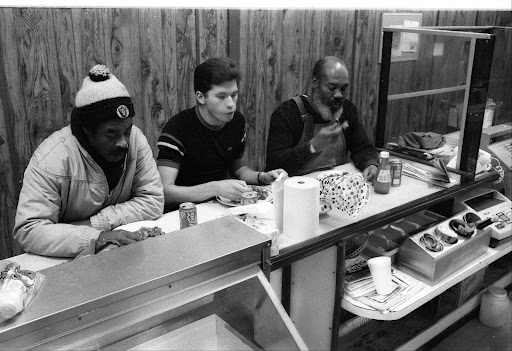
Tonight in Bangkok I had the privilege of sharing a meal with Kevin Eugene Smith. The son of the legendary LIFE Photographer W. Eugene Smith. Smith is an idol of mine who helped lead me into social documentary photography. His photograph "TOMOKO AND MOTHER IN HER BATH" I consider to be the greatest photograph ever made. It has inspired me, my entire life.

It was a fun evening and Kevin even paid for the meal, very generous and decent of him. Later I helped him a bit with some shopping. We will probably meet again at some point.

Kevin is a very interesting, exceptional and intelligent man in his own right and of course when he spoke of his dad and his dad’s work, I just ate that all up with eager ears. Every now and again a name like Johnny Depp (starred as W. Eugene Smith in the recent film Minamata), Nick Ut (famous photographer) and James Nachtwey (famous photographer) was dropped into the conversation to spice things up. 

A truly fun and memorable evening.

Saturday, February 1, 2025

Social Media Can be Cool!

So here is a social media can be cool story. 

As some of you that might read this blog occasionally might know, former LIFE Magazines W. Eugene Smith, is a photographer god to me. He has always been my main, probably my number 1 photographic inspiration. Without Smith I might have never made a social documentary photograph in my life. I consider his photograph "Tomoko in her Bath" the greatest photograph ever made. His depiction of a mothers love for her daughter is love in its most beautiful and pure form. I have spent hours looking at that photograph. Hoping someday I might make something 10% as powerful.

Smith passed in 1978 at 59, a year younger than I am now.

Blog Stories on Smith and the Tomoko photograph

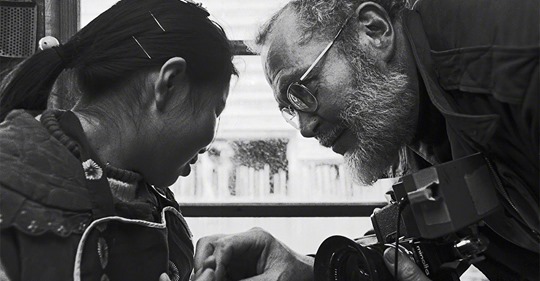
Smith photographing in Mimamata/. I love the caring heart he shows here.

So now let's get to the social media part of the story. 

5 years or so back I came across Smiths son on social media. He seemed like a nice, interesting guy, that had his father's heart/empathy and compassion, and we became online friendly. The years past, and we exchanged a friendly word now and again. We have the same political and photography views, and I loved his posts about his dad, and his own life.

Recently I made a post about my possible housing in Bangkok for my coming Thai 3-month trip. Smith's son wrote back that he will be in Bangkok at the same time. We might meet for a meal. If it happens it should be a fun and enjoyable evening. 

Social media is strange that way, so much terrible stuff comes out of it but some nice things as well. Gerry a security guard from Edmonton can meet up with his idol's son from America for a dinner in Thailand. Gotta love that! Hope it happens.

Tuesday, December 31, 2019

2 Wonderful W. Eugene Smith Portraits

Meeting a lot of W. Eugene Smith lovers of late (including one of his boys). Got this portrait of W. Eugene Smith from a new Facebook friend in Japans site.

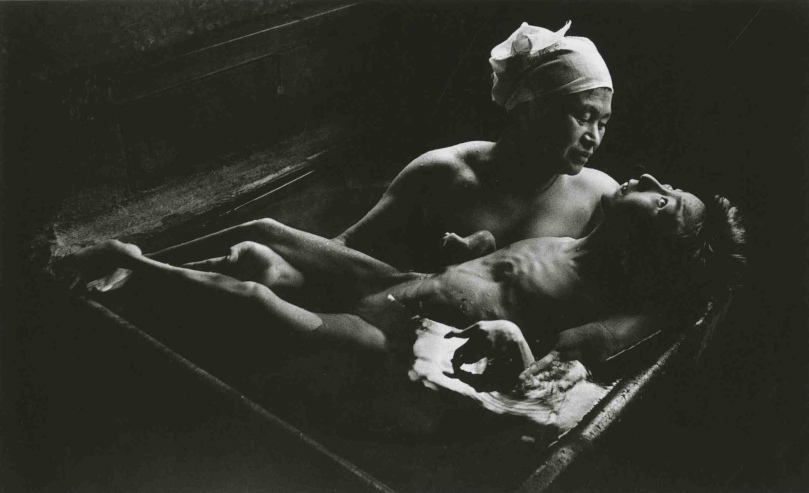
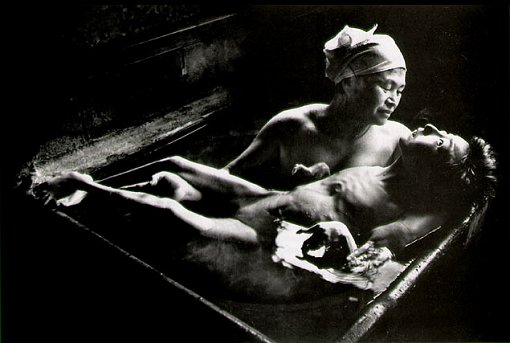
Smith with the greatest photo ever made, "Tomoko Uemura in her bath, 1971, Minamata Japan
Smith making photographs and sharing humanity in Minamata, Japan

Sunday, December 29, 2019

The "Tomoko Uemura In Her Bath", Photo Story

A Facebook friend sent me this link about the photograph I referred to earlier as the greatest ever made, "Tomoko Uemura in her bath". Here is the background story to the pic. I did not know that because W. Eugene Smith got beat up by goons from the company that was damaging the environment it lead to national exposure for the victims of the Minamata Japan Mercury poisoning. The beating badly injured Smith, who was already quite frail, for the rest of his shortened life. In the end thou, since he helped so many victims, his pain and suffering might have be worth it! This is a prime example of how social documentary photography, how photographs with heart and true human emotion in them, can cause positive change in the world. W. Eugene Smith will always be my photographer hero.

This story is from IconicPhotos. wordpress

Photo Story "Tomoko Uemura in her bath


Tomoko Uemura in Her Bath


flam2991
First housecats in Minamata, on the west coast of Kyushu in Japan, went berserk, jumping into the sea. Then it began to affect local fishermen, whose lips and limbs would tingle and then become numb. Their speeches slurred; many died. Women gave birth to deformed foetuses and blind children. It was termed Minamata disease, a neurological syndrome caused by severe mercury poisoning. Caused by methyl mercury in industrial wastewater from the Chisso Corporation’s chemical factory from 1932 to 1968, the disease claimed thousands of lives surreptitiously while the government and company did little to prevent the pollution.
It was a dramatic photographic essay by W. Eugene Smith in LIFE that brought world attention to the disease. Smith and his interpreter, a Japanese American student from Stanford University named Aileen Mioko Sprague (whom Smith would soon marry) were touring Japan for an exhibition of his works. They planned to stay in Minamata for three weeks, but ended up staying for three years. For eighteen dollars a month, they rented a house belonging to one of the victims, sharing a dirt-floored kitchen and bath, where they developed photos.
The most striking photo of the essay shows Ryoko Uemura, holding her severely deformed daughter, Tomoko, in a Japanese bath chamber. Tomoko was poisoned while still in the womb. The pieta of our industrial age, critics called it, and the photoessay was ‘a case study in Japanese politics’ the New York Times wrote. Although the photo was posed for Smith, the family subsequently asked the photo to be withdrawn from circulation. The picture does not appear in recent anthologies of Smith’s works.
A month after this photo, on January 7th 1972, Smith joined other Minamata victims at a demonstration at Chisso’s plant near Tokyo, where he was attacked and seriously injured by Chisso employees which left him with a permanently damaged eye and a crippled health. This attack made Smith a familiar face on local news. A Tokyo department store staged an exhibit of Smith’s photos, which was visited by 50,000 people in twelve days. The photos led the government to take more direct actions and the company to pay compensation. Tomoko died in 1977 at the age of 21.

Quote: W. Eugene Smith

Mr. Smith is my idol, the man who I most admire as a photographer, a true inspiration. He created what I believe is the greatest photograph ever made, Tomoko Uemura In Her Bath. 

Blogs About W. Eugene Smith

"I’ve never made any picture, good or bad, without paying for it in emotional turmoil.”

Thursday, April 4, 2019

Tonight In The Guardhouse

Got my books and my cameras with me tonight in the guardhouse. Am reading, learning (Gene Smith biography), and looking at photo books (for inspiration). One of the benefits of working as a security guard is that you sometimes have time to learn as you work, to think, to plan, to dream (no sleeping thou!).

The book on the lower left is "Just Another Indian" the tragic story of the serial killer deaths of 4 indigenous women and the indifference shown by Canada to those terrible murders.  The 2 photo books are Sebastiao Salgado's "Exodos" and W. Eugene Smith's "Minamata". The biography on the right is "W. Eugene Smith Shadow & Substance" (by Jim Hughes).

The cameras are a Leica 6.2 with 21mm F4 lens, and a Leica M4-P with a 90mm F2.8 lens. I also recently bought motor drive for the Leica SLR. Got the thing for $16.82 CAD. Not sure I will take it to Thai because of the weight, but it is a nice little addition to the shooting capabilities of the camera. I have never shot the M4-P in the field, but might take it to Thai with me this coming trip. Might also take the 90mm which I rarely use but thought it could give me more opportunities to vary my compositions somewhat. I usually shoot up close and personal but sometimes a longer lens is useful. Composing in that little tiny rangefinder window could be interesting thou. This M version 90mm lens is much smaller and lighter than if I bought something for the R body.

Note* Am also reading another Smith biography "Gene Smith's Sink A Wide-Angle View" (by Sam Stephenson). Thanks to my friend Larry in Texas for sending me this copy. Mr. Stephenson's moving account of seeing a 25x40 version of "Tomoko Uemura in her bath" got me all teared up this evening. I feel this is the greatest photograph ever made. It is shown in the open top right "Minamata" book. The photograph is about the ever lasting and unconditional true love a mother feels for her child. There is nothing in the world more beautiful than that. Her young daughter is a suffering from a birth defect as a result of Mercury poisoning. The beautiful young girl could neither speak or see. Smith wrote emotionally about the life of Tomoko, and about how he always saw her loved by her entire family.


Tonight's learning

Sunday, March 31, 2019

W. Eugene Smith's Darkroom

I find the whole antiseptic autopsy room darkroom thingy rather difficult to look at. A darkroom needs to have heart, it needs to have feeling to it, it needs to have history. The room should be a place of inspiration and creatively not a shiny stainless steel thing with nothing on the walls.  Check out my all time favourite photographers darkroom W. Eugene Smith. Smith was one of the greatest printers of all time and created in my view the greatest photo ever taken "Tomoko Uemura in Her Bath, 1971.

Here is a story on Smith and his darkroom, worth a look see.

http://www.oocities.org/minoltaphotographyw/

The great W. Eugene Smith, in his home darkroom space

Friday, March 8, 2019

Movie About Minamata And W. Eugene Smith!!!!!!!!!!!!!!!

This has to be great, I hope its beyond great.

Minamata Movie About W. Eugene Smith Staring Johnny Depp

Johnny Depp As Smith, And The Real W. Eugene Smith
Smith Photographing In Mimamata

 from Facebook:

Gerry Yaum Am really looking forward to this film. Smith is my hero, so much passion, emotion and heart in his work. He loved and truly cared for the people he photographed, would do anything to get the pictures and tell their important stories with compassion and feeling. He made what in my view is the greatest photograph ever taken (the story of a mothers love for her beautiful child) "Tomoko Uemura In Her Bath"

Gerry Yaum Wonder what Smith would have thought about gorgeous movie star Depp playing him. Great actor, very important role, hope this is a 4 star Oscar worthy film. In the picture Depp looks a lot like Smith, thought it was the real Smith for a second.

"Tomoko Uermura In Her Bath" 

Sunday, December 10, 2017

W. Eugene Smith Exhibiton At The Tokyo Photographic Art Museum

Saw a retrospective on my idol the great photographer W.. Eugene Smith. They had all his great photographs, I counted 22 images that I loved. The only image missing because of legal reasons and in my opinion the greatest picture ever made, Tomoko Uemura in her bath. Gosh I wish I could see this picture, spend a few days viewing it.

https://gerryyaum.blogspot.com/2015/03/links-joseph-saxton-gallery.html

The only problem I had with the show, was that I felt the prints were beautiful but looked a bit muddy, a bit too greys and were printed on a matt paper (do not like matt surfaces much) I would have though Smith printed a more moody, higher contrast and larger prints on a glossy surfaced paper.

It was overall a beauty exhibiti9n. I spent a few hours going through Mr. Smiths life in photos. I cannot think of a better way to spend a day.

Here is the Gallery that exhibited the work

TOP-TOKYO PHOTOGRAPHIC ART MUSEUM

Note* I always dreamed of seeing the Tomoko in her bath photo in tea life, maybe some day I can.

Friday, October 9, 2015

The Mother And Child In Art

Looking back through the history of art one of the most common themes (in various forms) is the mother and child. The theme being, the all encompassing love a mother feels for her child. This is such a noble subject, such in important story to tell. That is why it is revisited over and over again through the history of art.

I want to concentrate on finding and making an important mother and child photograph, something that will homage to love and motherhood. That search continues this coming photo trip.

Tomoko Uemura In Her Bath, 1971 by W. Eugene Smith
Migrant Mother" Florence Owens Thompson 32, Feb/March 1936 by Dorothea Lange
"The Pieta" sculpture by Michelangelo Buonarroti sculpture
Mother and child at the Korem camp, Ethiopia 1984 by Sebastiao Salgado
Mother and child with handkerchief by Pablo Picasso 1903
Sien nursing baby by Vincent Van Gogh 1882

Thursday, March 26, 2015

Links: Joseph Saxton Gallery

I found out about a wonderful world level photography gallery tonight located in Canton Ohio. The Joseph Saxton Gallary represents some of the most important photographers in history and seems to cater to documentary related themes. They allow online link submissions so I sent them some links from recent projects. I plan to continue to send them links in the future.

Joseph Saxton Gallery Canton Ohio

Here is a link to the Saxton collection page:

http://josephsaxton.com/saxton-collection

The galleries most recent acquisition is my favourite photograph of all time, Tomoko Uemura in Her Bath, 1971 by Eugene Smith. This photograph speaks to me of the absolute love a mother feels for her child. Smith created it when he was an older man (around 53, he died at 59), it gives me hope that maybe someday I can make something comparable.

Here is the photograph and the story about the image (written by the staff at the Joseph Saxton Gallery)
Tomoko Uemura in Her Bath, 1971 by Eugene Smith.
 W. Eugene Smith is best known for his iconic cultural portraits portrayed as extensive photo-essays. One of his last great exposés was that of mercury poisoning in Minamata, Japan. Smith and his wife lived in Minamata from 1971-1973 and documented the disease extensively. After a severe beating by employees from the Chisso chemical factory, Smith published one of his most famous works: Tomoko Uemura in Her Bath, 1971. We are thrilled to have acquired this piece and are proud to have it in the Saxton collection.

Monday, February 24, 2014

Steve McCurry's Blog

Here is a link to a blog by the great photographer Steve McCurry.

http://stevemccurry.wordpress.com

I found this blog when I was reading his thoughts on Eugene Smiths "Tomoko in her bath" photograph.

http://stevemccurry.wordpress.com/tag/minamata/

Dream Photo: My Own Mother With Child

While printing the last two photos both mothers with their children I was reminded of one dream photo I hope to make someday. A common theme in art is the "Pieta", Jesus dead in his mother Mary's arms. Great artists through out the history of art have created wonderfully powerful and moving images based on this theme. Eugene Smiths greatest photograph is of a mother holding her inflicted daughter (Minamata disease), her face glowing with love. Some time in my life I hope, I dream of making an important mother-child photograph, one that communicates an important universal message of love, hope and compassion. My photograph will not be in the class of the works below but I hope it can still be an important photograph.

Here are some other great mother child works that came immediately to mind as I wrote this blog, starting with the grandest of them all the "Pieta" by Michelangelo:

Pieta by Michelangelo Buonarroti 
Tomoko in her bath, Minamata Japan by W. Eugene Smith
Mother and child Korem refugee camp Ethiopia by Sebastiao Salgado
Mother with child Biafra by Donald McCullin

Wednesday, July 10, 2013

"Tomoko Uemura In Her Bath" Ethics

Found this story challenging, the ethics of the picture and its importance as a work of art versus how it effected the Uemura family.

http://digitaljournalist.org/issue0007/hughes.htm

Tomoko Uemura In Her Bath, 1971 W. Eugene Smith

Working In Low Light

With the new 35mm F1.4 I have more confidence working in low light, the pic below is of my friend Larry it was shot at 1.4 with available daylight and a fairly short shutter speed, possibly 1/30th.


With this new f1.4 lens and the ability to push Tri-x to 800 comfortably and 1600 uncomfortably I have the ability now to shoot pics in extremely low light. The one thing I want to work on in the coming months before my next trip to Asia is using bounce flash with the Leicas. Two of my all time favourite Eugene Smith photographs, "Tomoko In Her Bath" and "Albert Schweitzer At His Desk" were shot on 35mm with bounce flash (off a ceiling and a dirty floor). If I can incorporate bounce flash techniques into my arsenal of shooting methods, then I am really sitting pretty.

Saturday, June 15, 2013

W. Eugene Smith American Masters Documentary

Here is the American Masters documentary on W. Eugene Smith. Smith was my first major inspiration, as a photographer he is someone I greatly admire to this day. I always felt his incredible devotion to his work and that he felt so deeply for his subjects made him so good. If you look at his life's work the power and greatness of documentary photography is truly revealed. His photograph "Tomoko Uemura In Her Bath" is my favourite image of all time,  it speaks to undying, unequivocal love. Smith really felt deeply in his heart the importance and power of photography and art, he felt what he was doing really mattered.

http://www.youtube.com/watch?v=KCRIjL2rn3E

Here is a story on the Tomoko photograph from a blog I wrote way back in 2007.

http://gerryyaum.blogspot.ca/2007/11/favorite-photographtomoko-uemura-in-her.html

Sunday, March 6, 2011

Jim Hughes (Writer)

On Eugene Smith's photograph "Tomoko Uemura in Her Bath".

"Tomoko Uemura in her bath is about much more than Minamata. Today, it has transcended mercury poisoning and the many souls ravaged by the greed of a few. Far removed by time and space from a Japanese fishing village, the photograph, symbolic now, enables people to see in a signal image all the possibilities and dangers of life. To me, it is a constant, universal reminder that only through the kind of selfless love depicted in this photograph may the spirit of human spirit endure. The image of Tomoko and her mother is a as beautiful as it is terrifying. And it is true. This photograph among the most profound ever made: beyond a particular horror and tragedy, the image has come to represent compassion and humanity."

Thursday, November 26, 2009

Types of Photos


W. Eugene Smith

Philip Jones Griffith


I have been thinking what kind of photographs I want to make, what I should be trying to achieve.

Important subjects and forgotten people.

Lately I have been reviewing the work of 2 great humanist photographers, Philip Jones Griffith and W. Eugene Smith. Griffiths book Vietnam Inc. and Smith's book Minamata are both stunning examples of what a photographer can acheive. Both photographers shot important subject matter of forgotten people, they had a definite point of view, a subjective point of view which they translated into great photographs that told a meaningful story.

I need to find subject matter that inspires me that gets me angry that gets me motivated.


Philip Jones Griffiths: Brother Finds His Sisters Body, Vietnam

W. Eugene Smith: Tomoko In Her Bath, Minamata Japan

Sunday, December 14, 2008

Exploitation

A question keeps coming to my mind. How do you photograph something that is exploitative without exploiting the person your photographing?

The nature of photography demands that the photographer be in the room, live with the subject. He has to be physically at the place he is photographing (at least with traditional film based documentary photography). How can the photographer be at the location and making an image documenting some kind of injustice (exploitation) without himself exploiting his subject to some degree? Isn't the act of making the photograph also an act of exploitation? Does the end justify the means? If your making a photograph to inform, to educate, to raise awareness, if your making a photograph for the greater good does the end then justify the means?

Tomoko Uemura in her bath by  W. Eugene Smrth

In this great image by W. Eugene Smith he was documenting a birth deffect caused by mercury poisoning, he was educating the veiwer about this trajedy. Was he also exploiting the young girl and her mother? Or does the fact the image speaks to the horror of the birth defects through negligence and the obvious power of a mothers love allow the artist the right to exploit.

Does the creation of a great work of art allow the artist the right to be exploitive? I don't know.

Monday, November 19, 2007

A Favorite Photograph.....Tomoko Uemura in Her Bath


As powerful a depiction of love as any photograph ever made. This speaks to me on so many different levels it is difficult to put into words, photography cannot get much better. Smith's work in general and specifically this photograph have had a resounding influence on why I love photography and will continue to make photographs the rest of my life.

Some history on this very famous photograph.

W. Eugene Smith and his wife Aileen Smith lived in Minamata from 1971 to 1973, with the specific aim of bringing Minamata disease to public attention. During those three years Smith took thousands of photographs, leading to the production of numerous magazine articles, exhibitions and a book. Smith realised that a single, striking photograph was required to become a symbol of Minamata disease. In Smith's own words, "It grew and grew in my mind that to me the symbol of Minamata was, finally, a picture of this woman [the mother], and the child, Tomoko. One day I simply said […] let us try to make that symbolic picture".[1]

Tomoko's parents allowed Smith to photograph their daughter's body, in the hope that it might draw attention to the plight of similar families in Minamata and other pollution victims all over the world. Ryoko Uemura was keen for the photograph to portray her daughter in a sympathetic manner and actively collaborated with Smith to stage the perfect shot. Jim Hughes, (a biographer) said of Smith, "Although he wanted a photograph that would clearly show Tomoko's deformed body, Gene told me it was Ryoko Uemura, the mother, who suggested the bathing chamber".[2] The photograph was finally taken on a chilly afternoon in December 1971, with Ryoko, Tomoko, Smith and his wife Aileen all cramped into the small bathing room.

Tomoko Uemura died in 1977 at the age of 21.